Submissions
Submission Preparation Checklist
As part of the submission process, authors are required to check off their submission's compliance with all of the following items, and submissions may be returned to authors that do not adhere to these guidelines.Author Guidelines
TRABAJOS ACEPTABLES
CITAS Y REFERENCIAS
La citas (en el documento) y las referencias (al final del documento), se harán conforme a las Normas APA (Séptima Edición 2019), que se pueden descargar en la siguiente dirección web / URL: https://www.revista.unam.mx/wp-content/uploads/3_Normas-APA-7-ed-2019-11-6.pdf
- Citas: No incluir citas o notas a pie de página.
- Referencias: Todas las fuentes citadas en el documento deben aparecer al final del mismo, en la sección de referencias, en orden alfabético.
ETAPAS DEL PROCESO EDITORIAL EN PLATAFORMA
Los trabajos serán sujetos a un proceso editorial en etapas, durante el cual los autores (as) se comprometen a atender en tiempo y forma cada una de las recomendaciones, en la revisión preliminar por parte de la Coordinación Editorial, al igual que en la revisión a doble ciego por parte de dictaminadores externos expertos en el tema de interés. En caso de opiniones divididas, el Editor de la Revista decidirá si se envía a un tercer revisor, se acepta o se rechaza el documento.
1. Previo al envío de la colaboración
El editor de la Revista inicia el proceso con la emisión de la CONVOCATORIA.
Para que el autor de correspondencia tenga acceso a la plataforma y pueda subir el documento, será necesario que obtenga los datos de usuario y contraseña, proporcionados por soporte técnico de la Revista, debiendo escribir al correo revistadycs@uat.edu.mx
En respuesta al correo, se enviarán al autor (a) de correspondencia los datos para el registro en la Revista. En un archivo de formato Word, deberá especificar los datos personales e institucionales de cada autor, en orden de contribución.
2. Envío
En la primera etapa, el documento se encontrará en revisión preliminar por parte de la Coordinación Editorial, para verificar que se cumpla con los requisitos temáticos de la convocatoria; efectuar el análisis sobre el porcentaje de similitud con material publicado, a través del servicio de verificación de plagio iThenticate y; con la “lista de comprobación para la preparación de envíos”.
Nota: Aquellos trabajos que no cumplan con las normas editoriales, serán devueltos a los autores (as), para que las corrijan en un plazo de tres a cinco días hábiles, resaltando los cambios con color amarillo.
3. Revisión
En la segunda etapa, el Editor de la Revista enviará el documento a revisión a doble ciego por pares investigadores externos, expertos en el tema de investigación. El plazo de respuesta para la dictaminación será de 10 a 15 días hábiles.
Nota: Si en los dictámenes se hacen recomendaciones, el autor (a) se compromete a atenderlas en un plazo de 10 días hábiles, resaltando los cambios con color amarillo.
4. Editorial
En la tercera etapa, el artículo aceptado se encontrará en la etapa de corrección de estilo, además de la revisión sobre la traducción del título, resumen, palabras clave, figuras y/o tablas.
5. Producción
En la cuarta etapa, el artículo se encontrará en diseño y maquetación.
Se enviará al autor (a) las galeradas (prueba de galera), para que valide nombre/s de autor/es, institución de adscripción, código postal, ciudad, entre otros rubros de forma, además de autorizar la publicación. Tendrá un plazo de tres días hábiles para autorizarlo. En caso de no responder, se entenderá la conformidad de manera tácita.
6. Publicación
En la quinta etapa referente a la finalización del proceso editorial a través de la plataforma, el artículo se publicará en el volumen y el número de la edición correspondientes a la convocatoria en curso.
Archives
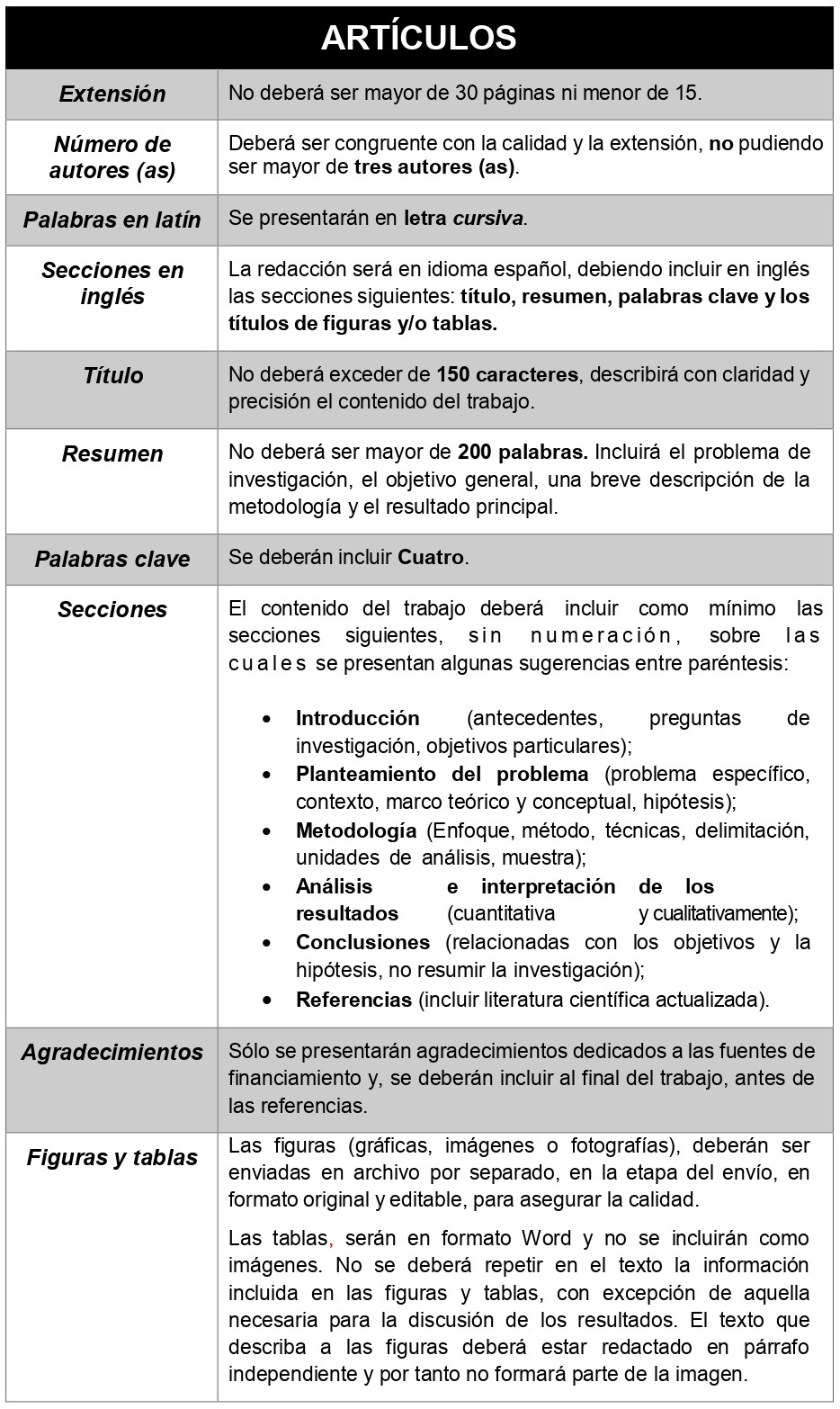
In articles, the title must not exceed 150 characters, clearly describing the content of the paper, and written in Spanish and English. In addition, a shorter version of the title must be provided. The abstract must not exceed 200 words, and will be written in both, Spanish and English. A list of four keywords must be included in both, Spanish and English. The abstract will include a brief introduction, the aim of the research, the methodology used, main findings and conclusions.
Reviews
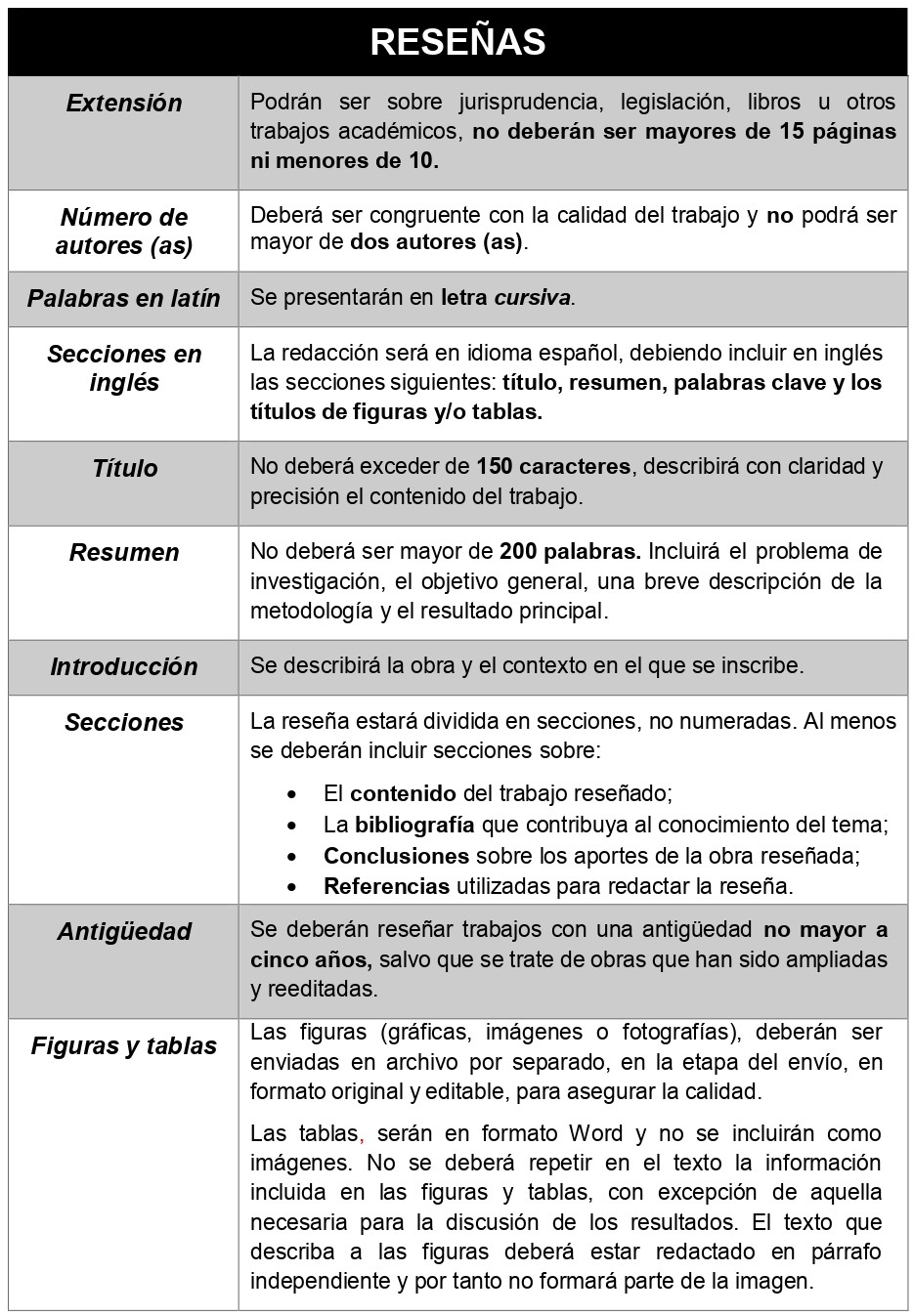
In updated literature reviews, the title must not exceed 150 characters, clearly describing the content of the work, and written in Spanish and English. In addition, a shorter version of the title must be provided. The abstract must clearly describe the topic examined, its relevance and scope, and must not exceed 200 words. The text of the document must contain a clear, broad review of the literature that facilitates a deep understanding of the topic described. In the Introduction, the importance of the study must be presented with an updated review of the scientific literature. The objective or purpose of the study must also be indicated. The content must be divided into sections, depending on the subject matter. It is recommended that a section of Conclusions be included before the list of References.
Privacy Statement
In accordance with its non-commercial open access policy, Journal DYCSVICTORIA provides free access to the full content of the journal in digital format through its electronic portal. Authors are also authorized to post the article in the version published by the Journal on their personal website or in an open-access repository, distribute copies of the published article in electronic or printed format to any interested party, and reuse part or all of the article in future articles or books, provided that appropriate acknowledgment is given to the Journal.
The names and email addresses entered in this journal will be used exclusively for the purposes established by the Journal and will not be made available to third parties or used for any other purpose.
Authors must declare that there are no conflicts of interest that could have influenced the results presented in their manuscript, the discussion of those results, or the conclusions reached.
In addition, authors must provide a written statement declaring that their manuscript is original and unpublished, and that its contents are the result of their own intellectual contribution. They also undertake not to submit the manuscript for consideration by another publication while it is under review by Journal DYCSVICTORIA, nor subsequently if it is accepted for publication.
Journal DYCSVICTORIA does not tolerate plagiarism. Therefore, all submissions will be screened using Turnitin's iThenticate similarity detection software to identify evidence of potential plagiarism (copying text or results from other sources without proper acknowledgment) or self-plagiarism (reproducing a substantial portion of one's own previously published work without appropriate citation while presenting the results as original).
If a manuscript exceeds 20% similarity with previously published content, it will be returned to the authors for revision and resubmission. If, upon resubmission, the manuscript again exceeds the established similarity threshold, it will be rejected.
Likewise, Journal DYCSVICTORIA is committed to preventing conflicts of interest throughout the manuscript evaluation process. Editors and reviewers participating in the peer-review process are required to disclose any actual or potential conflict of interest that could affect their impartiality, including conflicts arising from disagreement or antagonism with the research topic or line of inquiry addressed in the manuscript under evaluation. All manuscripts are evaluated under a double-blind peer review process.